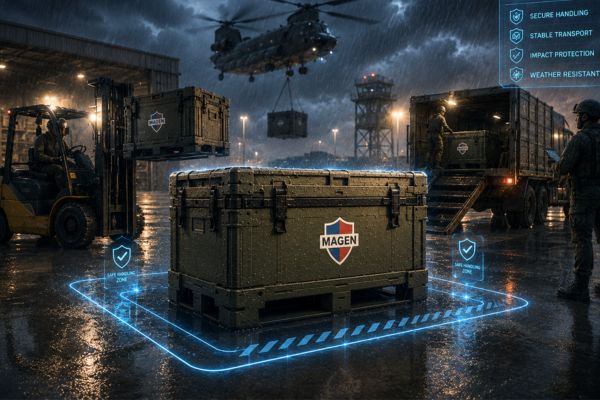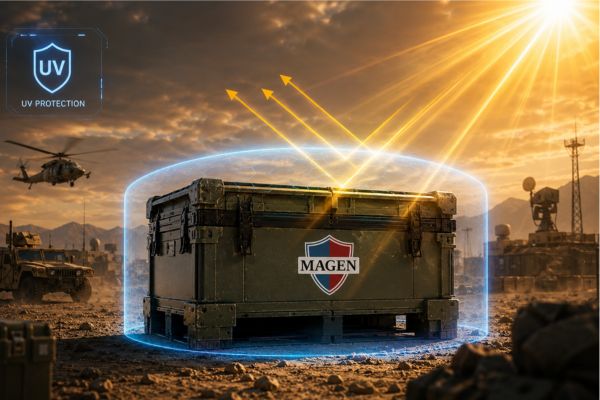
Many defense systems spend a significant portion of their operational life outside controlled facilities. They remain in staging areas, move through ports and logistics terminals, wait in deployment zones, and are often exposed for months — sometimes years — to constantly changing environmental conditions.
In these environments, one of the most underestimated operational threats is prolonged UV exposure.
Unlike mechanical damage or environmental contamination, UV radiation rarely creates immediate visible failures. Instead, it gradually weakens materials, reduces structural stability, and slowly affects the long-term ability of protection systems to preserve the sensitive equipment inside them.
In modern defense environments, where systems are expected to maintain operational stability and survivability over many years, even slow material degradation becomes a direct operational concern.
MAGEN systems were developed around the understanding that modern defense platforms operate in exposed and highly dynamic environments. This is why UV resistance is integrated as a core element within MAGEN’s overall operational survivability philosophy.
MAGEN is an operational protection platform developed by Teamnet, an Israeli company specializing in the development and manufacturing of advanced operational protection systems for defense and high-technology industries. Teamnet combines operational understanding, engineering expertise, product development, and advanced manufacturing capabilities to create mission-ready protection systems engineered for long-term operational performance under real-world defense conditions.
Sun Exposure Has Become an Operational Challenge
In the past, defense systems were often stored inside controlled facilities and relatively protected operational environments.
Today, operational reality is entirely different.
Modern defense systems move through global supply chains, cross continents, and remain in open operational environments for extended periods of time. In hot climates and desert regions, prolonged UV exposure becomes a significant factor directly affecting system lifespan and long-term structural performance.
Materials not engineered for UV durability may dry out, crack, deform, or gradually lose structural strength after extended exposure to sunlight and temperature fluctuations.
When sensitive mission-critical systems are involved, even gradual material degradation eventually affects operational capability itself.
One of the major challenges of UV-related damage is that it often remains invisible during the early stages. In many cases, the degradation only becomes noticeable after extended storage cycles or repeated exposure to harsh operational environments.
Long-Term Survivability Requires Advanced Materials
MAGEN systems are engineered using advanced polymers and specialized materials specifically designed to withstand harsh operational environments, including prolonged exposure to UV radiation.
The objective is not simply preserving external appearance. The real goal is maintaining structural integrity, operational stability, and long-term protection performance throughout years of transportation, storage, and deployment operations.
The integration of UV resistance together with protection against water, dust, corrosion, and harsh environmental exposure creates a comprehensive survivability platform tailored for modern defense environments.
In addition, this durability significantly reduces wear over time and minimizes the need for frequent system replacement cycles.
For defense organizations operating systems designed for long-term deployment readiness, this represents a major operational and logistics advantage.
The Damage You Cannot Immediately See
One of the most dangerous aspects of UV degradation is that the damage is often invisible during the initial stages.
A protection system may appear completely stable externally while the material itself has already lost part of its structural strength and long-term durability.
Under these conditions, accumulated environmental exposure may compromise protection performance precisely when the system faces vibration, operational stress, transportation loads, or harsh field deployment conditions.
MAGEN approaches long-term survivability as an inseparable part of operational readiness itself.
This is why UV resistance is not treated as a secondary feature or optional enhancement. It is engineered directly into the system architecture from the earliest development stages.
The combination of advanced materials, precision engineering, and adaptation to real operational environments allows MAGEN systems to preserve stable protection performance over extended operational lifecycles.
Teamnet Engineers Protection for Long-Term Operational Reality
Teamnet develops MAGEN systems with a broad lifecycle perspective focused on years of operational use under changing deployment conditions.
The systems are not engineered only for initial transportation phases. They are designed for long-term operational exposure across highly dynamic defense environments.
Every MAGEN platform is adapted according to expected environmental conditions, climate exposure, storage methods, transportation profiles, and operational mission requirements.
This philosophy enables Teamnet to deliver protection systems capable of maintaining structural stability and operational reliability even after prolonged exposure to demanding field environments.
Instead of dealing with accelerated wear and repeated replacement cycles, organizations benefit from operational protection systems engineered for long-term survivability and deployment continuity.
More Than Physical Protection
In today’s defense environments, survivability is no longer measured only by resistance to direct impact. It is also measured by the ability to maintain long-term stability under years of environmental exposure and operational use.
Through advanced materials engineering and high-level UV resistance, MAGEN delivers operational protection systems designed to address one of the most underestimated — yet operationally significant – challenges of modern defense logistics environments.
Teamnet’s philosophy connects environmental survivability directly to operational readiness, demonstrating that even the less visible aspects of protection engineering ultimately influence the mission capability of the entire defense system.