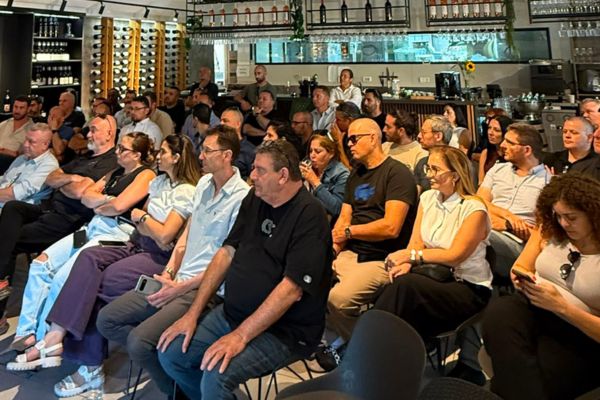
At two professional events hosted by Teamnet at Tulip Winery and Castel Winery, defense industry professionals came together to discuss protection and packaging solutions for sensitive equipment and systems. Throughout the events, a broader picture emerged: in today’s rapidly changing defense environment, the storage, transportation, and protection of systems are no longer technical stages at the margins of the production process. They are part of a continuous chain that determines whether a system will remain available and mission-ready when it is needed.
The conferences took place at a time when industrial independence, increased production capacity, inventory availability, and supply chain continuity have become central issues on Israel’s defense agenda. The realities of recent years have highlighted the close relationship between the ability to develop and manufacture advanced systems and the ability to preserve them over time, move them between locations, and ensure their operational readiness until the moment of deployment.
Against this backdrop, Maj. Gen. (res.) Yair Naveh, former Deputy Chief of Staff of the Israel Defense Forces, presented a broader perspective on Israel’s defense challenges and the growing importance of strengthening independence in the production and supply of defense equipment. His remarks naturally raised another question: what is required to preserve the investment in production capability once a system leaves the production line?
Readiness Is Built Across the Entire Chain
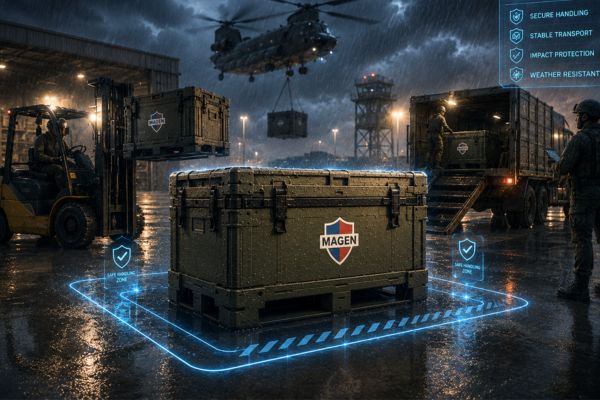
A defense system does not move directly from the factory to the operational user. Between production and deployment lies a logistics chain that may include long-term storage, transfers between facilities, ground transportation, sea or air freight, unloading, reloading, and exposure to changing environmental conditions. In many cases, a system will go through this cycle more than once during its service life.
This chain has a direct impact on system readiness. Water, dust, humidity, salinity, UV radiation, and temperature fluctuations can affect materials and components. Vibration, shock, and mechanical loads create additional risks during transportation. When dealing with electronic equipment, optical systems, sensors, communication systems, or precision assemblies, even damage that is not visible to the eye can affect performance and require inspection, calibration, or repair before the system can return to service.
Operational readiness, therefore, cannot be measured solely by the number of systems manufactured or held in inventory. It also depends on the condition in which those systems are preserved over time and the ability to transport them to the point of use without compromising their operational integrity. The more valuable, complex, and sensitive the systems become, the greater the importance of the protective solution that accompanies them throughout the supply chain.
Increasing Production Also Changes Logistics Requirements
The need to expand the domestic production capacity of the defense industry goes beyond establishing production lines and increasing output. Higher production volumes also increase inventory levels, storage requirements, and the number of logistics movements between factories, warehouses, military bases, and operational sites.
This means that investment in production capacity must be supported by an infrastructure capable of sustaining it. Systems manufactured at a higher rate must be transferred to appropriate storage conditions, preserved for periods that are not always known in advance, and remain available for rapid transportation when required. When logistics infrastructure is not aligned with production rates or the sensitivity of the equipment, a gap can emerge between the inventory recorded on paper and the inventory that is actually ready for use.
This leads to a broader understanding of the defense supply chain. Production, storage, and transportation are not independent systems connected only at transfer points. They are parts of a single integrated system, and every decision made at one stage affects the requirements of the others.
Protective Packaging as Part of Engineering Design
This shift in logistics thinking also changes the way the protective solution surrounding a system should be designed. Traditionally, packaging was developed primarily according to the product’s dimensions, weight, and method of transportation. In today’s defense environment, a broader engineering approach is required – one that considers the system’s entire logistics lifecycle.
This includes the equipment’s weight and center of gravity, sensitive components and points, expected storage duration, environmental conditions, transportation frequency, types of transport vehicles, and the number of use cycles the protective packaging is expected to withstand.
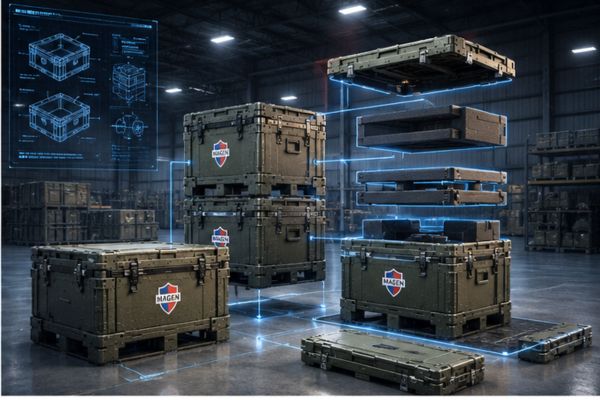
The way logistics teams interact with the system must also be considered during the design process. The location of lifting points, accessibility to the system, opening and closing procedures, and the ability to perform inspection or maintenance without fully disassembling the protective packaging all affect operational efficiency and the risk of damage to the equipment.
Protective packaging, therefore, cannot be selected solely according to external dimensions or load capacity. It must be engineered around the system itself, the environment in which it will operate, and the logistics process it is designed to support.
From Single-Use Packaging to a Reusable Protection System
This approach is the foundation behind Teamnet’s MAGEN solutions. They are designed as reusable protective systems that accompany equipment over extended periods rather than as solutions intended for a single shipment.
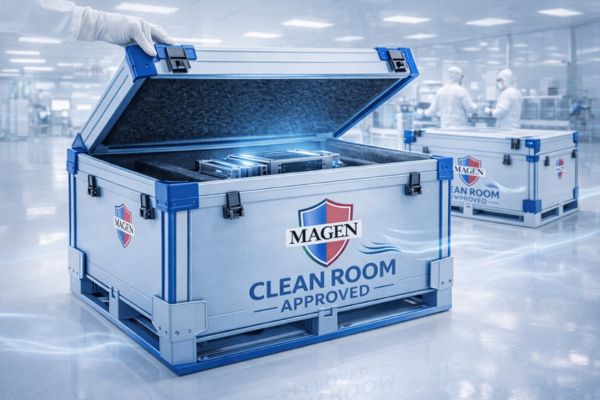
The use of advanced polymers helps overcome some of the familiar limitations of traditional solutions. The material does not rust, does not absorb moisture in the same way as wood, and can be cleaned and maintained between use cycles. At the same time, the engineered structure can be adapted to different load, transportation, and storage requirements.
The advantage, however, lies not only in the material itself. The combination of structural engineering, reinforcements, sealing, lifting points, and operational interfaces makes it possible to create a solution tailored to the characteristics of the system and the conditions in which it is expected to operate. For some systems, the design focus may be on resistance to water and dust. For others, greater emphasis may be placed on mechanical loads, vibration, outdoor storage, or frequent opening and closing.
This approach makes it possible to treat protective packaging as a permanent part of the system’s infrastructure, similar to other transportation or storage assets that accompany it throughout its service life.
Protection, Efficiency, and Standardization
A well-engineered protection solution also affects the efficiency of the logistics process. When the same protective system is used over time, standardized working methods can be established across factories, warehouses, and customer sites. Operational teams become familiar with the lifting points, procedures, and correct methods for handling the equipment. This reduces improvisation and minimizes dependence on packaging solutions that must be rebuilt for every shipment.
This standardization is particularly important for systems where response time is part of the operational requirement. A simpler unloading process, faster access to equipment, and protective packaging designed in advance around the relevant transportation methods can reduce the time between receiving the system and having it ready for use.
Here, too, logistics and readiness are directly connected. The quality of a protection solution is measured not only by its ability to prevent physical damage, but also by its ability to support a stable, repeatable, and predictable operational process over time.
From the Conferences to the Broader Challenge
The combination of Yair Naveh’s presentation and the engineering discussions held at the two conferences clearly illustrated the transformation taking place across the defense industry. Strengthening domestic industry and expanding production capacity are significant steps, but turning them into genuine operational capability requires looking at the entire system.
A system must be designed so that it can be manufactured at the required rate, stored over time, transported under changing conditions, and delivered to the point of deployment ready for use. Within this chain, protection solutions are not an accessory. They are part of the infrastructure that preserves the system’s operational value after it leaves the production line.
This was one of the key connections that emerged from the two events. The discussion surrounding industrial independence and defense readiness leads directly to questions of storage, transportation, and protection. As the defense industry expands its production capabilities and systems become increasingly advanced and sensitive, a more advanced generation of protection solutions is required as well.
Operational readiness is built throughout the entire journey – from design and production to storage, transportation, and arrival at the point of deployment. Protective packaging is part of that chain, ensuring that the capability created at the factory is preserved until the moment the system is needed in the field.