The wars of recent years have brought a question that had long been pushed to the margins back to the center of the defense debate: to what extent can a country afford to depend on others for the production of its essential ammunition? Speaking at the professional conferences hosted by Teamnet at Tulip and Castel wineries, Maj. Gen. (res.) Yair Naveh, former Deputy Chief of Staff of the Israel Defense Forces and the executive who led the relocation of IMI Systems’ operations from Ramat Hasharon to Ramat Beka, discussed the strategic significance of maintaining sovereign production capabilities for explosives, bombs, and artillery shells. Ramat Beka provides a large-scale Israeli example of how this approach can be translated into industrial policy and national infrastructure.
Technological advances on the battlefield have naturally focused attention on sophisticated systems: precision-guided munitions, unmanned aerial vehicles, intelligence systems, sensors, communications, and air defense. Alongside these capabilities, however, the prolonged conflicts of recent years have reinforced a more fundamental reality. Even a military equipped with the most advanced technology remains dependent, over time, on the ability to secure large and continuous supplies of ammunition, explosives, and energetic materials.
This was one of the key messages presented by Maj. Gen. (res.) Yair Naveh at the two conferences hosted by Teamnet. Drawing on his experience with the Ramat Beka project and his perspective on Israel’s ongoing conflict, Naveh emphasized the importance of sovereign domestic production capabilities, particularly in areas that for years were considered relatively basic. The ability to manufacture propellants and energetic materials, artillery shells, bombs, and ammunition at the required scale is not merely a matter of procurement efficiency. It directly affects a country’s freedom of action and its ability to sustain a prolonged conflict without becoming entirely dependent on the production capacity, inventories, and policy decisions of other countries.
This realization is not unique to Israel. The war in Ukraine exposed significant gaps in Europe’s capacity to manufacture basic ammunition. Research by the European Parliament found that Europe’s defense industrial base had been shaped for decades primarily around peacetime requirements and therefore struggled to meet the demands of a prolonged war. At the beginning of the conflict, European production capacity for 155 mm artillery shells amounted to only several hundred thousand rounds per year, while battlefield consumption was measured in thousands of rounds per day. In response, European countries began rapidly expanding production capacity, restoring production lines, and strengthening supply chains for explosives and propellants.
France, for example, resumed domestic propellant powder production after several decades. The new Eurenco facility in the Dordogne region was established as part of an effort to reduce dependence on imports and restore French and European control over one of the key materials required for artillery shell production. The European Union itself has directed a significant share of its investment program for increasing ammunition production specifically toward explosives and propellants, after identifying them as major bottlenecks in efforts to increase shell output.
From Global Efficiency to National Resilience
For decades, many defense industries operated according to an economic logic also common in civilian industries. International supply chains enabled countries and manufacturers to specialize in areas where they held an advantage, source components and raw materials from suppliers around the world, and maintain more limited domestic production capacity in areas considered readily available on the international market.
This model is efficient when supply chains operate under normal conditions. During a prolonged war, however, the underlying conditions change. Demand rises simultaneously across multiple countries, inventories are depleted, delivery times increase, and governments naturally prioritize their own national requirements. Even when reliable suppliers are available, their production capacity is not unlimited, and expanding a facility that manufactures explosives or ammunition is not something that can be accomplished within a matter of weeks.
This is driving a fundamental shift in defense thinking. Economic efficiency remains important, but another measure is now becoming equally relevant: industrial resilience. Countries must determine which capabilities they cannot afford to lose, which critical materials they must be capable of producing domestically, and where external dependence could restrict their freedom of action during an emergency.
This shift can also be seen in Israeli policy. In January 2025, Israel’s Ministry of Defense announced the establishment of a “national raw materials facility” for energetic materials, alongside plans for the domestic production of thousands of heavy air munitions. The Ministry explicitly described the initiative as part of a program to strengthen production independence and reduce reliance on imports. Additional agreements to expand ammunition production in Israel and establish new manufacturing capabilities had already been signed during 2024.
Ramat Beka as an Israeli Case Study
The Ramat Beka project demonstrates this approach on a large scale. In 2018, Yair Naveh was appointed by Elbit Systems to lead the relocation of IMI Systems’ operations from Ramat Hasharon to Ramat Beka in Israel’s Negev region. Rather than simply relocating existing factories, the project involves establishing a new production site and gradually transferring munitions manufacturing activities and production infrastructure to a newly designed complex.
In an Elbit Systems investor presentation, Ramat Beka was described as a new and advanced munitions manufacturing site covering approximately 52,000 dunams and comprising dozens of production facilities. In recent company reports, Elbit stated that production at the site had already begun and that activity was expected to scale up gradually throughout 2026 and beyond, while operations at Ramat Hasharon would continue until the relocation is completed.
The significance of Ramat Beka therefore extends well beyond transferring industrial activity from central Israel to the Negev. The project creates an opportunity to rebuild industrial infrastructure with a long-term perspective on production capacity, safety, future expansion, and adaptation to changing munitions requirements. In the context presented by Naveh at the conference, it represents an example of building capabilities controlled by the state and domestic industry rather than relying solely on the ability to purchase ammunition and critical materials from abroad.
According to Naveh, interest in Ramat Beka extends beyond Israel. Representatives from various countries have come to study the model and the way its new production infrastructure has been developed. This is understandable in light of the broader global trend: countries that previously reduced domestic production capacity are now attempting to rebuild capabilities that were lost over decades. The European Parliament has explicitly noted that reductions in defense investment following the Cold War led to diminished production capacity, the loss of professional expertise, and weakened supply chains – and that rebuilding these capabilities is both a slow and costly process.
Production Sovereignty Also Requires Storage Capacity
Expanding production capacity inevitably changes storage requirements as well. One of the objectives of higher production volumes is to enable countries to maintain larger strategic inventories and reduce dependence on immediate supplies from abroad. Alongside expanded production lines, therefore, infrastructure is required to store ammunition and sensitive materials safely over extended periods while maintaining their operational availability.
Storing ammunition and explosives is fundamentally different from conventional industrial storage. Safety requirements affect the distances between storage areas, the physical configuration of the site, accessibility, fire suppression and cooling systems, and security infrastructure. As inventory levels increase, the required footprint and operational complexity become significant elements of the overall planning process.
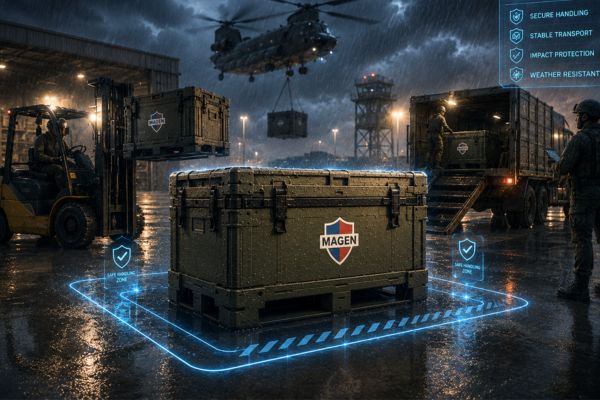
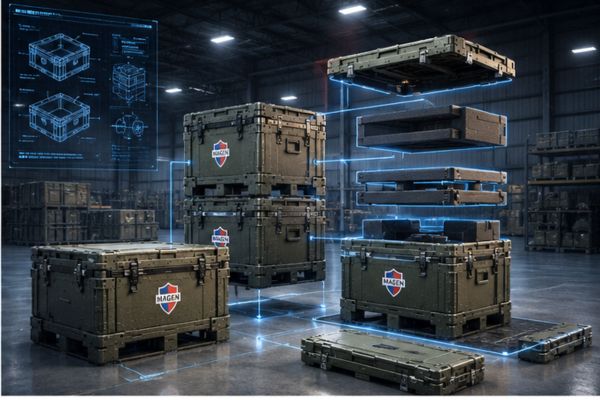
This is also where the strategic discussion presented by Naveh connects with the storage solutions presented by Teamnet at the conference. The MAGEN E-Storage concept is based on modular polymer storage units designed for ammunition and explosive materials. The solution presented addresses the reduction of required storage areas and safety distances, resistance to environmental conditions, operational accessibility, and a modular structure that can be adapted to different capacity requirements.
At a broader level, the conference also presented the concept of a storage facility composed of separate cells, with separation between storage areas, access to each individual unit, perimeter security infrastructure, and cooling and water-spray systems. In the design presented, each cell is intended to accommodate up to 100 tons, while the overall configuration is designed to enable capacity expansion by adding additional units while maintaining separation and clear site organization.
From an infrastructure perspective, the connection between these two issues is clear. The more a country seeks to increase its independence in ammunition production, the more it must simultaneously develop the ability to manage the resulting inventory – protecting it, storing it safely, and keeping it accessible over time. Production capacity that is not supported by appropriate storage infrastructure leaves the process incomplete.
From the Artillery Shell to Industrial Policy
The lesson emerging around the world in recent years goes beyond the number of rounds held in storage. It concerns the role of industry within the broader concept of national security.
Production capacity is not infrastructure that can simply be switched on once a crisis begins. It requires factories, technical expertise, raw materials, skilled workers, suppliers, regulation, and storage infrastructure that must be developed and maintained over many years. This is why countries are once again investing in capabilities that, for a long time, appeared less sophisticated than advanced weapon systems: propellants and energetic materials, explosives, shell bodies, and ammunition production lines.
The European Union has identified propellants and explosives as critical bottlenecks and directed most of the funding under its ammunition production expansion program toward these areas. France has restored production capabilities it had previously discontinued, while other countries are expanding facilities and seeking greater control over their supply chains.
In the Israeli context, Ramat Beka represents the same approach on a broad scale. It marks a shift away from dependence on aging and constrained infrastructure toward rebuilding an industrial base capable of expanding production and adapting to future requirements. Israel’s experience during the war, together with the interest that other countries have shown in the model, as described by Naveh in his presentation, places the project within a much broader international discussion about sovereignty, inventories, and wartime production capacity.
Ammunition sovereignty, therefore, is not simply a question of where an artillery shell is manufactured. It encompasses the entire capability chain – from raw materials and production, through strategic inventories and storage infrastructure, to ensuring that ammunition reaches operational forces at the required time and pace. The longer a conflict continues, the narrower the distinction between industry, logistics, and operational capability becomes, until all three effectively form part of the same national infrastructure.
Perhaps the most important lesson emerging from this discussion is that advanced technology remains a decisive factor on the battlefield, but the ability to continue operating that technology over time depends on a broad, stable, and sovereign industrial base. A country that maintains control over the production of essential munitions and the infrastructure required to store and preserve them also maintains a greater degree of freedom of action. In today’s changing defense environment, that freedom of action is once again becoming one of the fundamental components of national sovereignty.