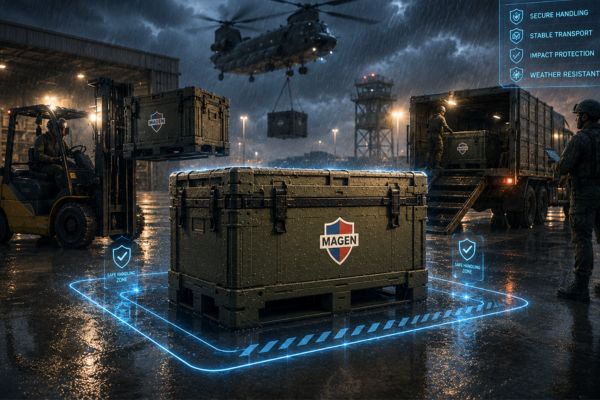
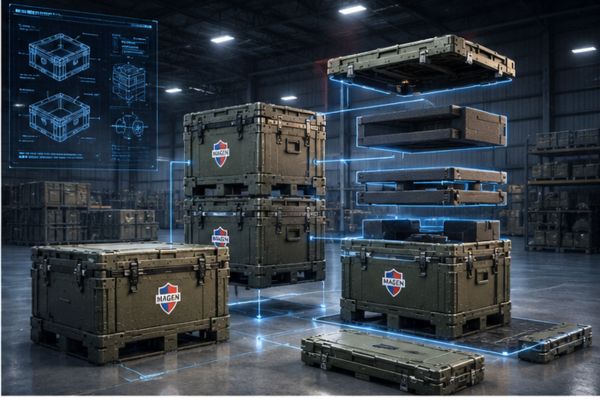
The continuous operation of industrial systems and critical infrastructure relies on a complex chain of engineering, logistical, and operational components. Based on this understanding, Teamnet developed MAGEN—a dedicated engineering solution designed to protect critical equipment over extended periods, even under demanding outdoor storage conditions.
While attention is typically focused on the systems themselves, one critical factor is often overlooked: the way high-value equipment is stored and protected over time. In Israel, infrastructure equipment, energy systems, control components, and emergency assets are frequently delivered from overseas in wooden crates. These crates are primarily designed for transportation—not for prolonged outdoor storage under harsh environmental conditions.
Once delivered, the equipment is transferred to regional warehouses, operational yards, or infrastructure sites, where it may remain stored for months or even years before deployment. During this time, it is exposed to rain, humidity, intense sunlight, heat, and temperature fluctuations—often without a protective solution suited to the duration and severity of this exposure.
Wooden Crates – A Temporary Solution That Became Permanent
Wooden crates provide an effective solution for transportation but are not engineered for long-term outdoor storage. When exposed to environmental stress over extended periods, their protective performance gradually deteriorates. Moisture penetration leads to swelling and deformation, fasteners and nails loosen, panels crack or rot, and overall structural stability is compromised.
Because this degradation occurs gradually, it is often not perceived as an immediate problem. However, the loss of protective integrity accumulates over time and may only become evident after significant damage has already occurred.
The Failure Point: When the Equipment Is Needed
The issue becomes critical at the moment of use. Maintenance operations, infrastructure projects, or emergency situations require fast and safe access to stored equipment. When wooden crates have deteriorated, serious risks emerge: unstable lifting, structural weakness, potential collapse, and direct safety hazards for field teams.
Beyond safety concerns, operational delays quickly follow. Equipment that is expected to be readily available cannot be released on time, often requiring improvised handling or re-packaging. In the context of critical infrastructure and emergency systems, such delays can directly affect service continuity and response capability.
A Shift in Perspective: From Packaging to Operational Readiness
This reality requires a fundamental shift in thinking. Packaging is not merely a means of transporting equipment from one location to another—it is an integral part of the operational system. Storage and protection solutions for infrastructure equipment must be evaluated over a multi-year horizon, not as a one-time logistical task.
This perspective drives the transition from single-use wooden crates to engineered protective solutions designed specifically for long-term outdoor storage. Such solutions maintain structural integrity, enable safe access, and ensure that equipment remains protected and operationally ready even after years of exposure.
Packaging as a Component of Operational Continuity
When packaging is treated as a functional operational component, decision-making changes accordingly. Environmental conditions, future equipment usage, access frequency, lifting methods, and safety requirements are all taken into account from the outset.
Within this framework, equipment protection becomes part of the overall system design rather than an afterthought. This approach reduces risk, lowers long-term costs, and enables organizations to preserve critical assets in a safe, accessible, and ready state.
Looking Ahead
In an environment where critical infrastructure demands high availability, reliability, and rapid response, outdated assumptions no longer apply. Outdoor storage of high-value equipment requires solutions that are engineered for this purpose—not temporary measures that remain in place beyond their intended use.
MAGEN, Teamnet’s engineering solution, was developed in response to this need: to provide a dedicated, long-term protective solution for critical infrastructure and emergency equipment, ensuring safety, structural stability, and operational readiness. When packaging becomes part of the system rather than a temporary shell, organizations can be confident that their equipment will remain protected, accessible, and ready for operation—even after years of outdoor storage.