Emergency equipment is a critical component of national infrastructure continuity. Electrical systems, backup components, and sensitive operational assets must remain available and ready for use at all times—often after long storage periods and without advance notice. In this context, storage and protection are not merely logistical considerations, but an integral part of operational readiness.
During long-term outdoor storage of emergency equipment at an electric utility facility, it became evident that the wooden crates originally used for storage no longer provided adequate protection. Continuous exposure to rain, humidity, and temperature fluctuations led to severe deterioration of the crates, compromising both safety and accessibility.
The Problem: Long-Term Outdoor Storage in Wooden Crates
The equipment had originally been stored in wooden crates designed for transportation, not for prolonged outdoor storage. Over time, the condition of the crates deteriorated significantly: wooden panels decayed, fasteners loosened, and overall structural stability was lost.
As a result, basic handling operations became hazardous. Lifting, opening, or repositioning the crates posed real safety risks to field teams. Beyond safety concerns, a serious operational issue emerged—emergency equipment that was required to be immediately available could no longer be accessed safely or efficiently.
The Need for an Immediate, Practical Solution
The challenge was not theoretical. The equipment could not be removed from the damaged wooden crates or repackaged through a lengthy refurbishment process. A solution was required that could address the existing field conditions: sensitive equipment already stored outdoors, inside compromised wooden crates, and required to be fully ready for emergency use.
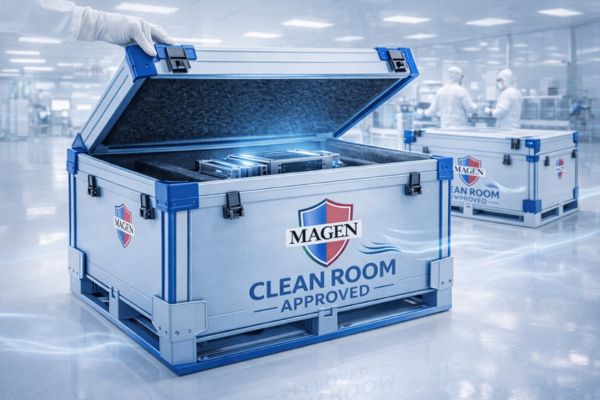
To meet this need, MAGEN—TIMANT’s engineered solution was implemented, based on protective frame plastic crates designed specifically for long-term outdoor storage of infrastructure and emergency equipment.
The Solution: Protective Frame Plastic Crates
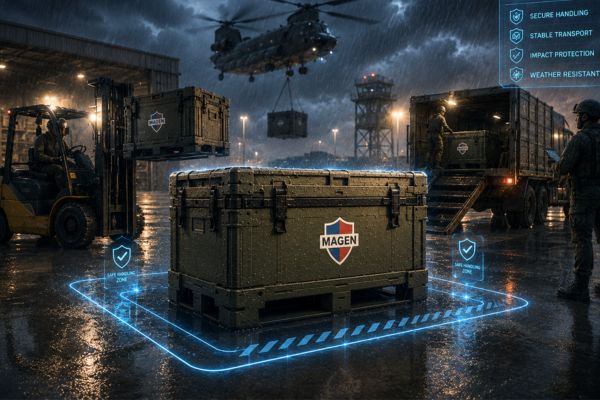
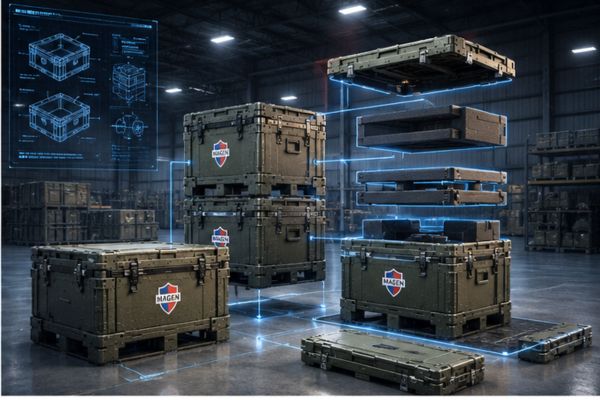
As part of the project, reinforced protective frame plastic crates were engineered and deployed. These crates function as rigid external structural frames, providing long-term stability and environmental resistance. The design allows the existing wooden crates to be fully contained within the protective plastic frames, without dismantling the equipment itself.
The solution included:
- Reinforced protective frame plastic crates for long-term outdoor storage
- Full protection against rain, humidity, and solar radiation
- Structural stability enabling safe lifting and handling
- Dedicated locking and closure mechanisms
- Full compatibility with standard lifting and hoisting equipment
This approach restored structural integrity and safety while preserving the existing equipment configuration.
Field Implementation: Teams, Equipment, and Winter Emergency Readiness
A key factor in the project’s success was the ability to execute the solution on site, within a short timeframe, and without reliance on external contractors. TIMANT operates skilled packing and implementation teams with extensive experience handling sensitive infrastructure equipment, supported by dedicated lifting and hoisting machinery.
TIMANT’s teams arrived on site with the protective frame plastic crates, lifting equipment, and all required tools for field deployment. The teams handled the existing wooden crates and critical equipment, placed them into the protective plastic frames, secured and locked the units, and repositioned them in accordance with defined safety and operational procedures.
The operation was carried out as a proactive winter-readiness measure, ensuring that emergency equipment would remain protected, accessible, and operational even under severe weather conditions.

Results: Restored Emergency Readiness
Following implementation, the emergency equipment was once again stored in safe, stable, and durable conditions. Safety risks to field teams were significantly reduced, and access to the equipment became fast, controlled, and reliable.
This project demonstrates how a purpose-built engineering solution, combined with professional field execution, enables not only future protection but also the rehabilitation of an existing storage failure, restoring critical equipment to a state of full emergency readiness.

A Broader Perspective
This project reflects the core value of MAGEN—TIMANT’s engineered solution: an integrated approach combining engineering design, protective frame plastic crates, skilled field teams, and lifting capabilities to address real-world challenges. Through this approach, emergency equipment stored outdoors for years can remain protected, accessible, and ready for operation—exactly when it is needed most.