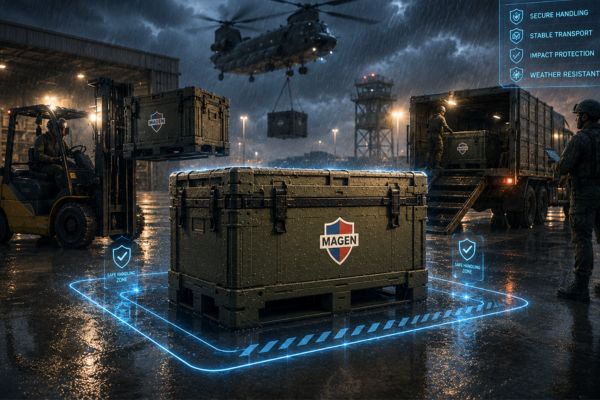
The Problem – High Weight in Confined Spaces on Deck
On small vessels and in armories, handling is often done by hand through crowded routes and challenging clearances. Wooden or metal containers add significant tare weight and increase physical effort for every move, especially as activity volume rises or when continuous handling is required over a shift. At the same time, footprint and rigid geometries that are not optimized for hand-carry make maneuvering harder on ladders, sharp turns, and small hatches. The outcome is slower handling rates and higher load on crews, precisely in the areas most critical for readiness.
Managerial Implication – Longer Prep Times and Operational Risk
Excess weight directly impacts timelines and manpower utilization. More crew are required per move, handovers become more frequent, and load/unload rates drop. Accumulated physical strain raises the risk of slips or loss of grip — events that create delays, reduce equipment availability, and make readiness targets harder to meet. At the organizational level this means slower ship preparation, longer operational windows, and higher resource allocation to a single task at the expense of others.
MAGEN’s Solution – Lightweight, Ergonomic, Sea-Ready Plastic Cases
MAGEN’s approach starts with weight reduction without compromising protection:
- Low tare weight that eases hand-carry, ladder transitions, and maneuvering through tight openings.
- Full sealing against water and dust to protect ammunition and sensitive electronics in harsh marine conditions.
- Salt resistance for reduced maintenance and stable performance over time at sea.
- Field ergonomics: comfortable carry handles at multiple points, improved grip zones, and tie-down points for carts, lifts, and anchor stations.
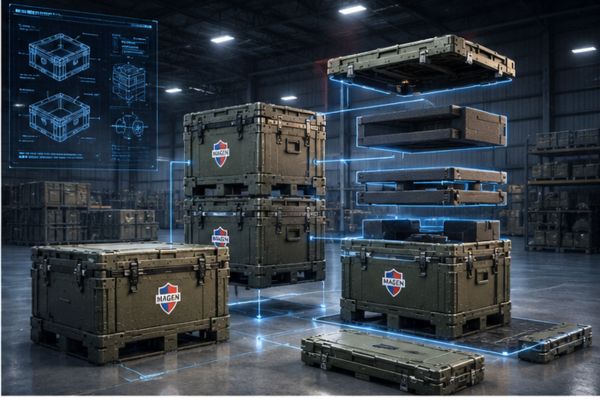
- Stable, modular stacking that supports efficient layering on deck and in storage while maintaining low centers of gravity and compatibility across payload types.
- Purpose-built internal inserts to manage shock, isolation, and vibration for each kit profile — from ammunition to optics and electronics — preserving Ready-to-Use status on arrival.
The compounded benefit is felt on deck: fewer people per move, less effort per unit, and higher handling rates in the bottleneck segments of the route. The combination of salt-resistant plastic and modular architecture produces a solution that is more efficient over time — operationally and economically — through lower maintenance, shorter preparation windows, and better equipment availability.
KPIs – Measuring Impact and Driving Continuous Improvement
To quantify value and focus training, adopt a fixed metric set in every rollout:
- Load/unload time per unit.
- Average handling rate in tight segments (units per hour on ladders and through hatches).
- Crew-to-task ratio (how many people are required per move).
- Rate of hand-carry safety incidents (slips, loss of grip, unplanned stops).
- Ready-to-Use availability of equipment after handling and storage (percentage of items immediately deployable).
Tracking these KPIs enables clear before/after comparisons, targeted crew coaching, and scalable improvements across similar classes of vessels.
Next Step – MAGEN Technical Support
MAGEN’s plastic protective cases provide a focused answer to weight and movement challenges in compact naval environments: easier to carry, easier to operate, and better protected over time. For a focused discussion of weights, grip layouts, inserts, and a measurement plan, MAGEN’s technical service team is at your disposal. We will review your mission profile, recommend a tailored configuration, and support implementation until measurable KPIs are achieved on deck.
For MAGEN Technical Support Press hire